 SmartLockPro
Digital locks fail differently from mechanical ones. A mortice lock gets stiff for months before it gives up; a keypad works perfectly on Tuesday and is dead on Wednesday. That suddenness is what makes people assume the worst and start shopping for a replacement.
Usually they do not need one. Of the failures we get called to, most come down to four causes, and three of them cost nothing to put right. It is worth ten minutes working out which you have before anyone spends money — including us.
1. The batteries, which is most of them
Far and away the most common cause, and the most misdiagnosed, because a digital lock rarely dies cleanly. As the cells drop it does odd things first: the keypad lights but will not accept a code, the fingerprint reader gets fussy, the motor sounds strained, or it opens from the app but not from the keypad. People read that as a fault in the lock. It is a fault in the batteries.
Three things worth knowing. Use alkaline, not rechargeable — rechargeables sit at a lower voltage and some locks read them as flat when they are not. Change all of them together, never a mix of old and new. And if a fresh set dies within weeks, the problem is not the batteries, it is something making the motor work far harder than it should — which is usually cause number three.
2. Codes and fingerprints that stopped being valid
Not a fault at all, though it feels like one. Temporary and one-time codes expire by design. So do codes tied to a booking, and on some systems a code will stop working simply because it was not used for a set period.
Fingerprints drift for a different reason. A print registered once, quickly, in warm dry conditions can read poorly months later on a cold wet morning — the skin genuinely presents differently. Deleting and re-registering that finger, taking your time and capturing it from several angles, fixes it more often than people expect. It is worth registering the same finger twice, as two entries, for exactly this reason.
3. The door moved, not the lock
This is the one that gets misread most expensively, because the symptom appears at the lock and the cause is nowhere near it.
Doors move with the weather. A timber door swells in a wet autumn; a composite door expands in direct sun; hinges drop over years. When the door sits even a few millimetres out, the bolt no longer lines up cleanly with the keep in the frame, and the lock motor is suddenly fighting the door every time it throws. You get slow operation, straining, batteries that last weeks instead of a year, and eventually a motor that gives up.
The tell is simple: open the door fully and operate the lock with it standing open. If it runs smoothly in mid-air and struggles when the door is shut, the lock is fine. The door needs adjusting — hinges, keeps, or the strike plate — and replacing the lock would have fixed nothing while costing a few hundred pounds.
4. The lock has actually failed
Sometimes it really has. Water gets into an outward-facing keypad that was never rated for a fully exposed door. A motor or gear wears out. The board fails. Cheap units bought on price from a marketplace listing fail this way much sooner than good ones, and often cannot be repaired at all because no parts exist and no manufacturer answers the phone.
Be honest about the economics at this point. Individual parts for consumer smart locks are rarely available in the UK, and where they are, the labour to strip and rebuild a unit usually costs more than a better lock. Repair genuinely makes sense for commercial hardware and for the odd flagship model with a real spares chain behind it. For most domestic locks, replacement is the honest answer.
What replacing one actually involves
Better than most people fear. If the old lock was fitted properly, the cut-out in the door is already there, and a like-for-like replacement is a straightforward swap.
The door below is a real job from earlier this month. The old Yale keypad on the left had failed, and the owner had never liked how it operated. Two complications: the previous cut-out had been chipped away, leaving less sound timber than we would want to fix into, and the door carries a glazed panel — so putting the new lock body where it would normally go risked cracking the glass. It went in below the glazed section instead. Slower to do, no risk to the glazing, and a solid fixing.
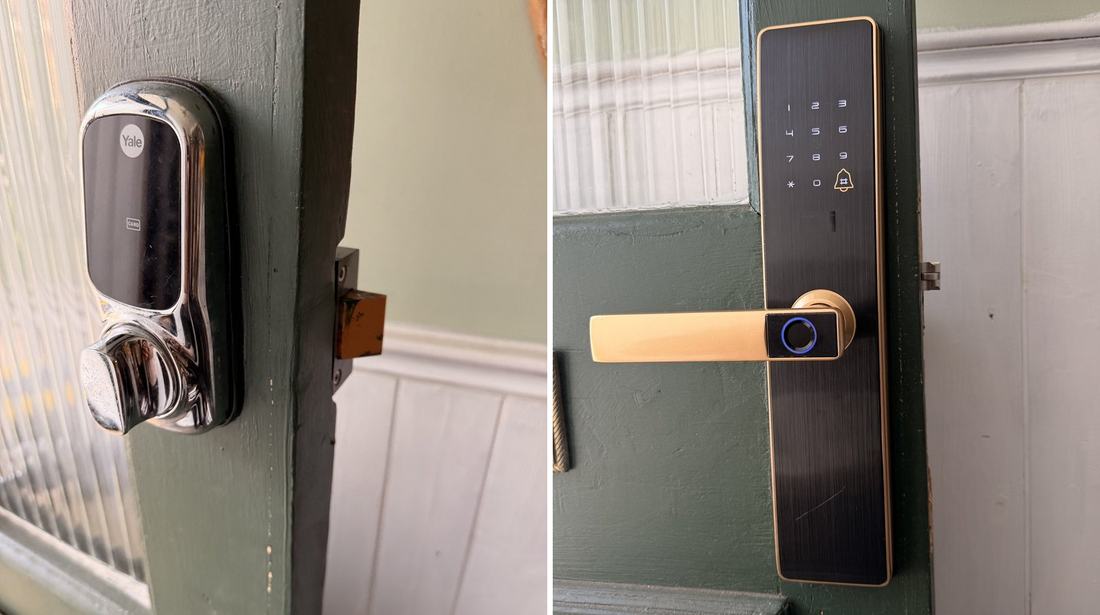
The replacement opens four ways — fingerprint, PIN, card and app — with a mechanical key as the fallback for when the batteries eventually go. Read the whole job in the timber door case study.
Before you buy a replacement
Two things are worth checking, because they decide whether a swap is simple or turns into carpentry.
What is behind the door edge. A uPVC or composite door almost certainly has a multipoint mechanism, and that mechanism — not the brand of lock — decides what can replace it. There is a full write-up of what fits uPVC and composite doors, including the cases where the answer is no.
Whether the existing cut-out is sound. Different makes put their fixings and spindle in different places. A replacement in the same footprint is a swap; one that needs a new cut-out in a door already weakened by the last one is a different job, and worth knowing about before you order rather than on the day.
If you would rather we looked at it
Send a few photographs before anyone travels: the lock, the edge of the door with it open, and the frame where the bolt goes in. That is usually enough to say whether you are looking at a battery, a door adjustment or a genuine replacement — and roughly what it would cost.
We cover Manchester and the Northwest, and we will tell you when the answer is something you can sort yourself for the price of four batteries. We would rather do that than sell you a lock you did not need. Send them through the contact page or call.